You Pay a $1 Million Penalty: Inside the Economics of Yield Maintenance

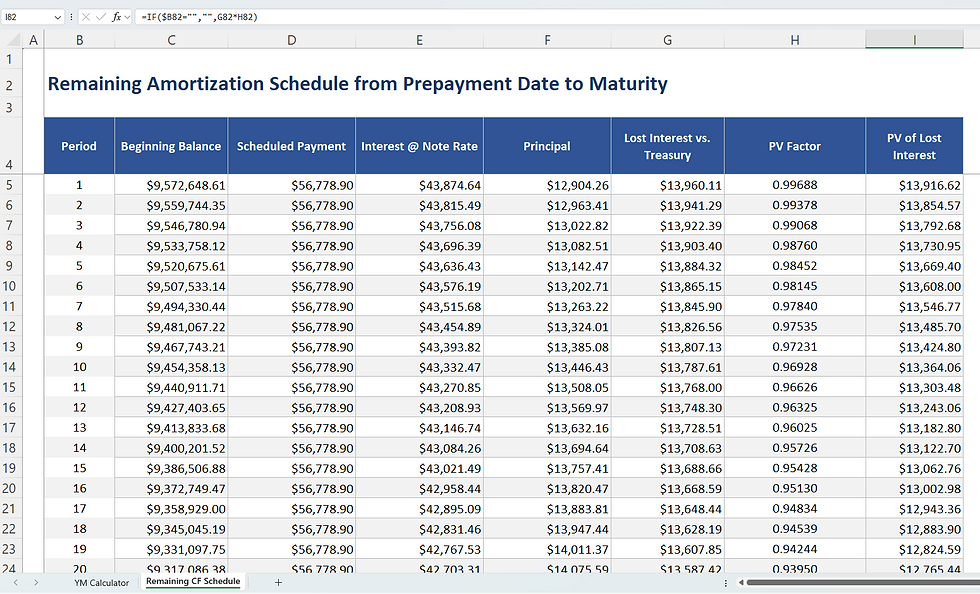
This article walks through why a borrower might want to prepay a commercial real estate (CRE) loan, how a yield maintenance clause changes the math for both borrower and lender, and the economic logic behind it using the attached model. It uses a U.S. CRE-style example from the model: a $10 million, 5.5% fixed-rate loan with a 10‑year term and 30‑year amortization, prepaid after three years.


Why prepayment may be needed
Prepayment usually happens because the borrower’s business plan moves faster than the loan: they sell the asset, refinance at a lower rate, pull out equity, or de-lever to clean up the balance sheet. In the U.S. CRE market, this is common in value‑add multifamily or office deals where sponsors underwrite a 3–5 year hold but lock in 7–10 year agency or life‑company debt for cheaper pricing.
In those cases, by year 3–4 the borrower may want to:
Sell the property and deliver it unencumbered to the buyer.
Refinance into cheaper debt because Treasury and credit spreads have tightened.
Refinance to increase leverage based on a higher appraised value.
Replace a fixed‑rate loan with floating‑rate debt to pursue a different strategy.
Without a prepayment penalty, this early exit would shift interest‑rate and reinvestment risk to the lender, who was originally compensated to hold the loan to term.
What yield maintenance actually does
Yield maintenance is a prepayment premium that aims to leave the lender in roughly the same economic position it would have been in if the loan had remained outstanding to maturity. In plain English: it tries to “maintain” the original yield to the lender by charging the borrower the present value of the lender’s lost interest margin.
Most U.S. CRE yield maintenance language follows the same pattern:
Take the scheduled remaining payments of principal and interest.
Separate the “note rate” cash flows from what the lender could earn by reinvesting at Treasury rates.
Compute the present value of the difference (the “lost interest”), using a discount rate tied to a U.S. Treasury of similar maturity, sometimes plus a contractual spread.
Charge the borrower the greater of this present value amount or a floor (often 1% of the outstanding balance).
The attached model is a textbook implementation of that structure.
Borrower impact: how this changes the economics
Cash impact at prepayment (refer model)
From the borrower’s perspective in this modeled U.S.‑style CRE deal:
Without yield maintenance, they would pay roughly the outstanding balance: $9.57M.
With yield maintenance, they pay $10.54M, about $0.97M more.
If the borrower is selling the asset, this $0.97M comes straight out of sale proceeds or equity and materially lowers their equity IRR. If they are refinancing, it effectively increases the “refinance cost” and can entirely offset the benefit of a lower new coupon.
Rate and timing sensitivity
The attached model shows several key sensitivities (even if not explicitly parameterized as toggles):
The earlier you prepay, the more remaining payments, so the sum of lost interest is higher.
The lower the Treasury yield relative to the note rate, the larger the rate differential and the larger the penalty.
If Treasury rates rise above the note rate, the PV of lost interest drops toward zero, and the penalty collapses to the floor (here, about 1% of balance).
In practice, this means:
Yield maintenance is most punitive when you prepay early in a falling‑rate environment (typical of sponsors who locked high fixed rates and then see rates drop).
It is least painful when you prepay late in the loan term or in a rising‑rate environment, which is why many U.S. borrowers try to line up their exit closer to maturity or negotiate “open periods” where the penalty burns off.
Strategic implications for sponsors
For U.S. CRE sponsors, the model highlights why underwriting must consider both the ongoing coupon and the potential exit penalty:
A 5.5% rate may look attractive at origination, but the yield maintenance structure can lock the borrower into the debt unless rates move favorably.
Sponsors often model exit scenarios using this same PV of lost interest logic to test whether a refinance or sale still meets their IRR targets after paying yield maintenance.
Lender impact: why lenders like yield maintenance
From the lender’s side, the attached model illustrates how yield maintenance protects the economics of the deal.
Yield preservation
Lenders underwrite a loan at a target spread over Treasuries and expect to earn that spread for the life of the loan. The model’s “Rate Differential (Note − Treasury)” line (1.75%) is essentially that spread.
By charging the present value of lost interest, the lender:
Converts future spread income into an upfront cash payment at prepayment.
Neutralizes reinvestment risk when the borrower exits in a low‑rate environment.
Keeps portfolio yield closer to its original target, even if several loans prepay.
Balance sheet and pricing strategy
This structure allows U.S. CRE lenders (life companies, CMBS, agencies) to:
Offer lower headline coupons than they otherwise would, because yield maintenance limits downside if borrowers prepay.
Match asset and liability durations more confidently, since early prepayment still provides cash equivalent to the lost spread.
Differentiate products: “low‑rate with yield maintenance” versus “higher‑rate with more flexible prepayment.”
The attached model’s 1% minimum penalty floor ensures that even in a high‑rate environment where Treasury yields exceed the note rate, the lender still receives a modest premium (here, about $95k) at prepayment.
Economics behind yield maintenance: tying it together
The economic backbone of yield maintenance is straightforward once you see the attached model:
The loan generates a stream of interest at the note rate (5.5% here) over time.
If the borrower prepays, the lender can reinvest the principal at the current Treasury rate (3.75% here).
The “lost interest” each period is the difference between those two rates applied to the then‑outstanding balance.
Discounting this lost interest stream at the Treasury rate returns the present value the lender needs today to be indifferent between holding the original loan and reinvesting at Treasury after prepayment.
The minimum floor is a contractual protection so the penalty never fully disappears, even if the underlying economics would suggest a very small or negative PV of lost interest.
If you plan to exit a deal early or believe rates might move significantly, the logic in the attached model is exactly what you need to build into your underwriting assumptions.


Comments